
Is Pilates Strength Training? Muscle Fibers, Progressive Loading and Healthy Aging
Pilates can build strength. Whether your practice provides enough challenge depends on the exercises, how they progress and what you want your body to be able to do.
By Shannon Smith, Pilates &
Should you do Pilates or lift weights? Does Pilates work different muscles? And if your Pilates class feels challenging, does it count as strength training?
These questions often turn exercise into a competition between methods. But the name of a workout tells us less than we might think.
Pilates can be a form of resistance training and can improve strength. The important questions are whether it challenges the muscles you need to train, whether that challenge progresses and whether it supports your goals.
A gentle mobility session, a demanding mat class and a progressively loaded equipment session can all fall under the Pilates umbrella. They do not provide identical training.
Understanding muscle fibers and progressive loading helps us make better choices—especially when we want to stay strong, mobile and capable as we age.
Does Pilates count as strength training?
Resistance training asks your muscles to work against a force. That force can come from gravity and your body weight, resistance bands, springs, free weights or machines.
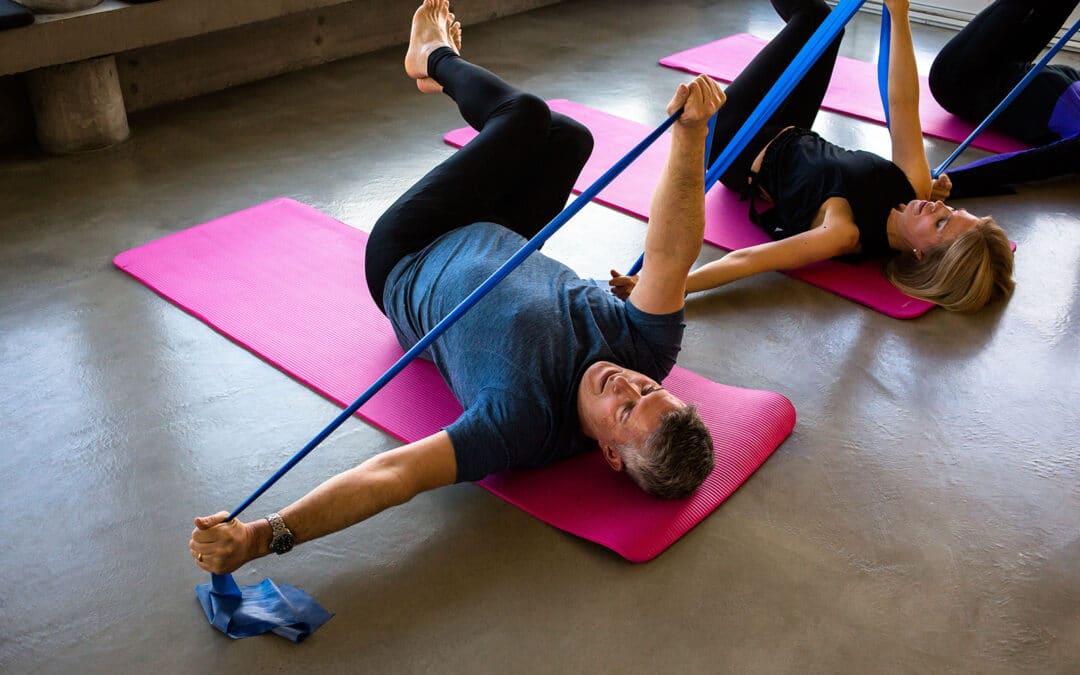
Pilates uses several of these tools. Supporting your body in a plank, pressing against a spring or moving against a resistance band can challenge your muscles.
However, participating in resistance exercise and receiving enough stimulus to improve a particular capacity are different questions. An exercise that builds strength for a beginner may become primarily a maintenance or endurance exercise for someone more experienced.
Research supports Pilates’ potential to improve strength. In a small randomized trial, 32 older adults completed either equipment-based Pilates or stretching twice weekly for 12 weeks. Pilates improved measures of knee muscle strength and balance. That supports the studied program; it does not establish that every Pilates class delivers the same results or replaces every other form of training. [1]
Strength, endurance and power: what are you training?
We often use “strength” to describe any difficult muscular effort. It helps to distinguish several capacities:
| Capacity | What it means | Everyday example |
|---|---|---|
| Muscular strength | How much force you can produce | Lifting a heavy suitcase |
| Muscular endurance | How long you can sustain or repeat effort | Carrying groceries over several blocks |
| Muscular power | How quickly you can produce force | Pushing off quickly to climb a step |
| Balance and movement control | Managing your position and coordinating movement | Staying steady while reaching |
| Mobility | Moving through the range an activity requires | Reaching overhead or getting down to the floor |
A Pilates practice can address several capacities. Controlled movement often gives endurance and coordination substantial attention. Maximum strength and power may require additional programming.
A longer hold is a different challenge from lifting heavier resistance or producing force quickly. Improving one capacity does not automatically improve all the others equally.
Type I vs. Type II muscle fibers
Most skeletal muscles contain a mixture of fibers. Their proportions vary between muscles and people.
| Fiber type | Main characteristics | Typical contribution |
|---|---|---|
| Type I: slow-twitch | Slower contractions, high oxidative capacity and strong fatigue resistance | Sustained effort and postural support |
| Type IIa: fast-twitch | Faster contractions with substantial oxidative and glycolytic capacity | Repeated demanding efforts involving strength and speed |
| Type IIx: fast-twitch | Fast contractions, high power potential and greater fatigability | Brief efforts requiring rapid, substantial force |
Type IIa fibers have characteristics between endurance-oriented Type I and more readily fatigued Type IIx fibers. These categories describe tendencies. Type I fibers do not belong exclusively to endurance exercise, and Type II fibers are not exclusively anaerobic. Energy systems contribute together, with their relative contribution changing according to the task. [2]
You do not need to identify your fiber proportions to choose an effective workout. The practical issue is what you ask your muscles to do.
Does Pilates mainly work slow-twitch fibers?
Many Pilates exercises involve sustained, controlled effort, which is consistent with the role of fatigue-resistant motor units. But this does not justify a blanket claim that Pilates selectively trains Type I fibers.
Your nervous system recruits motor units—a motor neuron and the muscle fibers it controls—to meet a task’s demands. In many contractions, lower-threshold units are recruited before higher-threshold units as force requirements increase. [3]
Demand can increase because resistance is greater, leverage is less favorable or fatigue makes maintaining the effort more difficult.
Moving slowly does not prevent fast-twitch fibers from participating.
A laboratory study examined resistance exercise performed to task failure using different loads and repetition durations. Its findings supported activation of both fiber types across those conditions. This helps explain why lighter, controlled exercise can recruit fast-twitch fibers when sufficiently demanding. It does not establish the fiber recruitment of a particular Pilates class. Nor does it mean every set should end in failure. [4]
Why does Pilates feel like it works different muscles?
Pilates can change the job a muscle is doing.
You may be familiar with moving your leg but less familiar with doing so while keeping your pelvis steady. You may lift a substantial weight yet find it challenging to support your body in a position requiring unfamiliar coordination.
Pilates asks you to notice these relationships: how the trunk supports the limbs, how the shoulders organize during a push and how you manage movement without unnecessary tension.
Deep muscles such as the transversus abdominis and multifidus contribute to trunk support. But “stabilizer” describes a role, rather than a separate class of muscle fibers. Stabilization involves coordination among multiple muscles.
A new sensation, shaking or soreness cannot tell you which fibers were recruited—or prove an exercise is superior.
You may be using familiar muscles in a less familiar way.
Progressive overload: how your practice keeps developing
When someone recommended that I add strength training, my GP’s advice was more specific: not necessarily, provided I was progressively loading my body.
That was guidance about my circumstances. What I took from it was a useful question:
Is my practice continuing to challenge the capacities I want to maintain or improve?
Progressive overload means adjusting training demands as your body adapts. It does not require making every session harder. It means providing an appropriate stimulus over time, with enough recovery to respond.
In Pilates, that might involve changing resistance, leverage, range, repetitions or sets. The change should have a purpose.
| Progression | Example | What to consider |
|---|---|---|
| Increase resistance | Use a more demanding band for the same exercise | The intended muscles should still do the work |
| Change leverage | Lengthen a limb when appropriate | A small change can substantially increase demand |
| Increase body-weight loading | Progress a supported push-up toward a less supported version | Preserve suitable control |
| Increase range | Use a greater controlled range where appropriate | Suit the range to your joints and goals |
| Increase volume | Add repetitions or another set | This increases work but may emphasize endurance |
| Adjust springs or support | Change equipment assistance or resistance | Springs can resist or assist, depending on the movement |
These are teaching examples, rather than a sequence everyone should follow.
A balance variation may improve coordination while reducing how much force you can produce. A complicated exercise may be difficult to learn without being the best way to load a particular muscle.
Progression works best when you know what you are trying to improve.
What about light hand weights?
Light hand weights can be useful in Pilates, particularly when the arms create long levers or the movement requires precise control.
The weights recommended in the Pilates Prop Guide relate to the movements and formats described there. They are not a universal upper limit for strength training.
A weight suitable for a long-lever arm exercise may be too light to provide a meaningful strength challenge for a squat or hip hinge. The exercise, muscle group and person all matter.
How can you tell whether your practice is progressing?
Choose a few exercises or everyday tasks to observe over time.
Can you use greater resistance with similar control? Complete more repetitions at the same resistance? Perform a movement with less assistance? Get up from a chair or the floor more confidently?
Record the exercise, resistance, repetitions, support and how demanding it felt. Comparing similar conditions is more useful than comparing exhaustion after two very different classes.
For strength-focused work, the intended muscles should face a meaningful challenge. When an exercise becomes consistently easy, review whether to progress it.
Burning, sweating and soreness are not required evidence of progress. Better capacity is the outcome you are looking for.
When should you add weight training?
Adding weights may help when your practice no longer offers enough resistance, leaves important muscle groups underchallenged or does not match a specific goal.
External weights can make loading easier to measure and increase. They may be particularly useful for developing greater maximum strength.
Lighter loads can also support muscle growth when sufficiently demanding. In a trial involving resistance-trained young men, lighter and heavier training performed to failure increased both Type I and Type II fiber size. This finding concerns the studied programs; it does not prove that a typical Pilates class produces equivalent muscle growth. [5]
ACSM’s 2026 guidance recognizes benefits from bands, bodyweight and home-based resistance training. It distinguishes heavier loading for strength from faster lifting with moderate resistance for power, and emphasizes training all major muscle groups at least twice weekly. [6]
You might continue Pilates for the movement skills you value and add targeted resistance work for capacities needing more attention. The combination can be tailored to your life.
Pilates, bone health and healthy aging
Healthy aging requires more than one kind of fitness. Strength helps us manage loads. Endurance helps us sustain effort. Balance helps us stay steady. Power helps us produce force promptly.
Bone health needs its own consideration. A strong muscle sensation does not establish that an exercise provides enough stimulus to improve bone density.
Canadian osteoporosis guidance supports progressive resistance training alongside balance and functional training. Impact exercise should be selected and progressed according to fracture risk and physical fitness. Walking and other enjoyable activities remain valuable additions. [7]
If you have osteoporosis, a previous fragility fracture or relevant spinal concerns, progression should account for your healthcare guidance. Increasing difficulty may mean changing resistance or support rather than adding deep spinal flexion, twisting or impact.
Explore jumping in place and bone health for related reading. If pain, injury or a change in function affects your choices, Physical Therapy vs. Pilates explains how to choose appropriate support.
Choosing the right next step
Ask yourself:
- What do I want to be able to do more easily?
- Which muscle groups and movement patterns does my routine challenge?
- How has that challenge progressed?
- Am I addressing strength, endurance, balance and power where needed?
- Can I sustain the routine and recover well enough to continue?
A beginner may benefit from foundational movement and building confidence. An experienced student may need more resistance. Someone returning after injury may need coordinated support from a healthcare professional and an exercise teacher.
There is room for Pilates, weights, walking, dance and other movement you enjoy. Each should earn its place by helping you meet a need.
Frequently asked questions
Can mat Pilates build strength without a Reformer?
Yes. Body weight and leverage provide resistance, and suitable props can add challenge. Whether that is enough depends on your capacity and goals.
Do I need advanced Pilates exercises to recruit fast-twitch fibers?
No. Recruitment depends on demand, rather than an “advanced” label. A simple exercise can require substantial force.
Is a longer hold always better?
A longer hold challenges sustained effort. It does not automatically provide the best stimulus for maximum strength or power. Choose the duration for the goal.
Can Pilates replace the gym?
For some goals and people, a sufficiently challenging Pilates program may provide useful resistance training. Others may need additional loading or dedicated power work. Review the program and your progress.
Build a practice that grows with you
At Pilates &, I want students to understand what they are doing, recognize how their practice is developing and connect it to the life they want to lead.
The question is whether your routine provides the challenge your body needs—and how that challenge progresses over time.
Explore Pilates & classes, small groups and private sessions to find an appropriate starting point or review the next step in your practice.
Strong body. Calm mind. Balanced life.
Research and further reading
- Effects of Pilates on muscle strength, postural balance and quality of life of older adults: a randomized, controlled, clinical trial (2015).
- Skeletal Fiber Type in Muscle Pain and Dysfunction (2026).
- The demonstration of the size principle in humans using macro electromyography and precision decomposition (1996).
- Muscle fibre activation is unaffected by load and repetition duration when resistance exercise is performed to task failure (2019).
- Morton et al.: Neither load nor systemic hormones determine resistance training-mediated hypertrophy or strength gains in resistance-trained young men (2016).
- ACSM updated resistance training guidelines (2026).
- Clinical practice guideline for management of osteoporosis and fracture prevention in Canada: 2023 update.
Contact Us
Create a Free Account
Receive weekly emails with workouts, tips & offers to help you live more vibrantly.